The Politics of Seeing everything from Nowhere
A Conversation with Dr Joanne Yao (Queen Mary) about her 2026 Earth Day Keynote
22 April was Earth Day – once again. Since its humble beginnings as campus teach-ins in the US at the beginning of the 1970s, Earth Day became a global phenomenon in the lead-up to the 1992 Rio Earth Summit. And it is no coincidence that the Paris Agreement, the most recent international climate treaty, opened for signature 10 years ago – on 22 April 2016.
The symbolism of Earth Day is carried by a particular aesthetic, optic and epistemic position – of seeing the Earth as a whole. But what precisely does this perspective consist of? What does it enable and foreclose? What, in short, are its political implications?
In her 2026 Earth Day Keynote for the British International Studies Association Joanne Yao, Reader in International Relations at Queen Mary, unpacked the planetary image for us. In this blog, I reflect with Joanne on her lecture and what it means to ‘see everything from nowhere’.
The Power to See the Earth and the Optics of ‘Epistemic Completion’
Laura: In 1968, during the height of the Cold War, Apollo 8 took the iconic Earthrise photograph: a picture of the blue planet rising over the barren surface of the moon. As two opposing political blocs competed for technological superiority, spacecraft were celebrated as symbols of national pride and astronauts became carriers of national flags. The newly developed ability to travel to space enabled visualizations of the Earth, as a whole, which had previously been unavailable. Modern ideas, intuitions, and institutions have been powerfully mediated through these images – Earth Day is one of them.
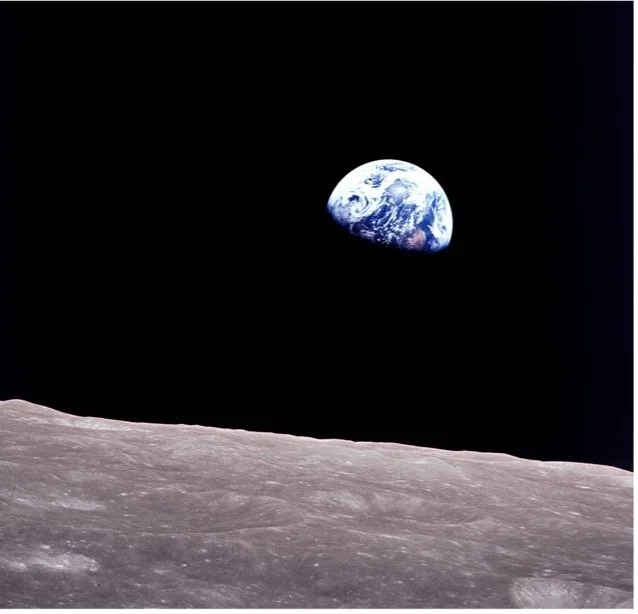
Apollo 8, ‘Earthrise’, Credit: NASA
The fascination with the view of the Earth from space, however, is not a dusty thing of the 20th century. Think, for instance, of Orbital, the 2024 Booker Prize-winning novel by British writer Samantha Harvey. Set aboard the International Space Station, the story details the crew’s mundane routines, memories, and human struggles as they loop around the Earth and marvel at its beauty.
Or think of the spectacular images recently taken by the Artemis II mission, providing new updated shots of planet Earth from space.
Laura: Drawing on your Earth Day Keynote, could you take us through these optics and explain how they relate to what you refer to as ‘epistemic completion’?
Joanne: I think for us, the optics of Earthrise have become so ubiquitous that they appear as unnoteworthy, even ‘natural’. We tend to forget that the image was framed by a man with a camera. For environmentalists, the image symbolizes the fragility of spaceship Earth. For poets like Archibald MacLeish, it became a celebration of humanity. And for Apollo 8 commander Frank Borman, it evoked a sense of awe, being one of the first humans to ‘see the world in its majestic totality … this must be what God sees’. But for me, the image is a culmination of a certain way of seeing the earth as a ‘totality’ where all parts fit into a beautiful whole that can be measured and known, and therefore conquered, through what I call epistemic completion.
Epistemic completion has its roots in the European Scientific Revolution that sought to understand the natural world through the systematic gathering of scientific knowledge. It was further advanced by the Age of Discovery and colonialism that enabled European scientists to establish networks and infrastructures to gather data from all around the world. In the 19th century, science such as meteorology, oceanography, and the study of magnetism necessitated the view of Earth as an integrated whole – and understanding that whole required coordinated efforts to see from everywhere all at once.
The best early example I have found to describe epistemic completion comes from John Ruskin, who in 1839 argued for the need to devote more resources to meteorology because it differed from previous science where ‘a Galileo, or a Newton, by the unassisted workings of his solitary mind, may discover the secrets of the heavens’. Instead, meteorology required that ‘individuals should think, observe, and act simultaneously’ to gather information from around the world through networks that become ‘one mighty Mind – a ray of light entering into one vast Eye – a member of a multitudinous Power’.
Laura: This historic account is fascinating, Joanne. It really helps us to appreciate how the epistemological positionings which we take for granted are indeed products of technological, scientific and political possibilities and ambitions. I feel your account of the quest for epistemic completion is also highly relevant for contemporary efforts to understand AI-supported planetary models, such as the European Commission’s Destination Earth (DestinE) project. The aim of this so-called ‘digital twin’ is precisely ‘to model, monitor and simulate natural phenomena, hazards and … human activities’ at the level of the Earth as a whole. And as Mitchell, Halpern and Schmidgen observe, these AI-driven quests for epistemic completion ‘presume that human … expertise can neither grasp the enormous volume of information generated by global natural systems … nor adjust … at the necessary speed’, thus adding another dimension to the optics of seeing everything from nowhere.
Utopian Escapism: Unseeing ‘Earthbound Hierarchies’
Laura: Drawing again on your Earth Day Keynote, could you speak to how the quest for epistemic completion unsees what you refer to as ‘Earthbound hierarchies’?
Joanne: Seeing everything from nowhere, or what Donna Haraway famously called ‘the God-trick’, is an act of zooming out that also became an act of escape. By abstracting outwards, the utopian hope is that we can distance ourselves from conflicting particularistic interests and see humanity as a whole – and through this new sight, we can detach ourselves from the mistakes of the past and violences of earthbound politics to create more peaceful and cooperative futures. However, I follow Haraway in arguing that all sight is situated. So the escape to totality allows us to see more in some ways, but it also produces blind spots and erasures that reinforce and reinscribe the same injustices that we are trying to escape.
To reveal some of the histories and injustices that space exploration is tethered to, I follow the infrastructures of the grand adventure of space exploration back to Earth. I’ll offer one example – that of the Mauna Kea, Hawai’i, where efforts to build the Thirty Meter Telescope have met with Indigenous resistance. Some scientists were puzzled by this – as one researcher told the New Scientist: ‘Astronomy is about as pure and clean as you get, so what’s the big deal?’ Of course the big deal is that for Indigenous Hawaiians, Mauna Kea is a sacred place and home to deities, not the empty mountaintop that outsiders see. There are already 13 telescopes on Mauna Kea with the oldest built by the US Air Force in 1968, the same year as Earthrise was taken.
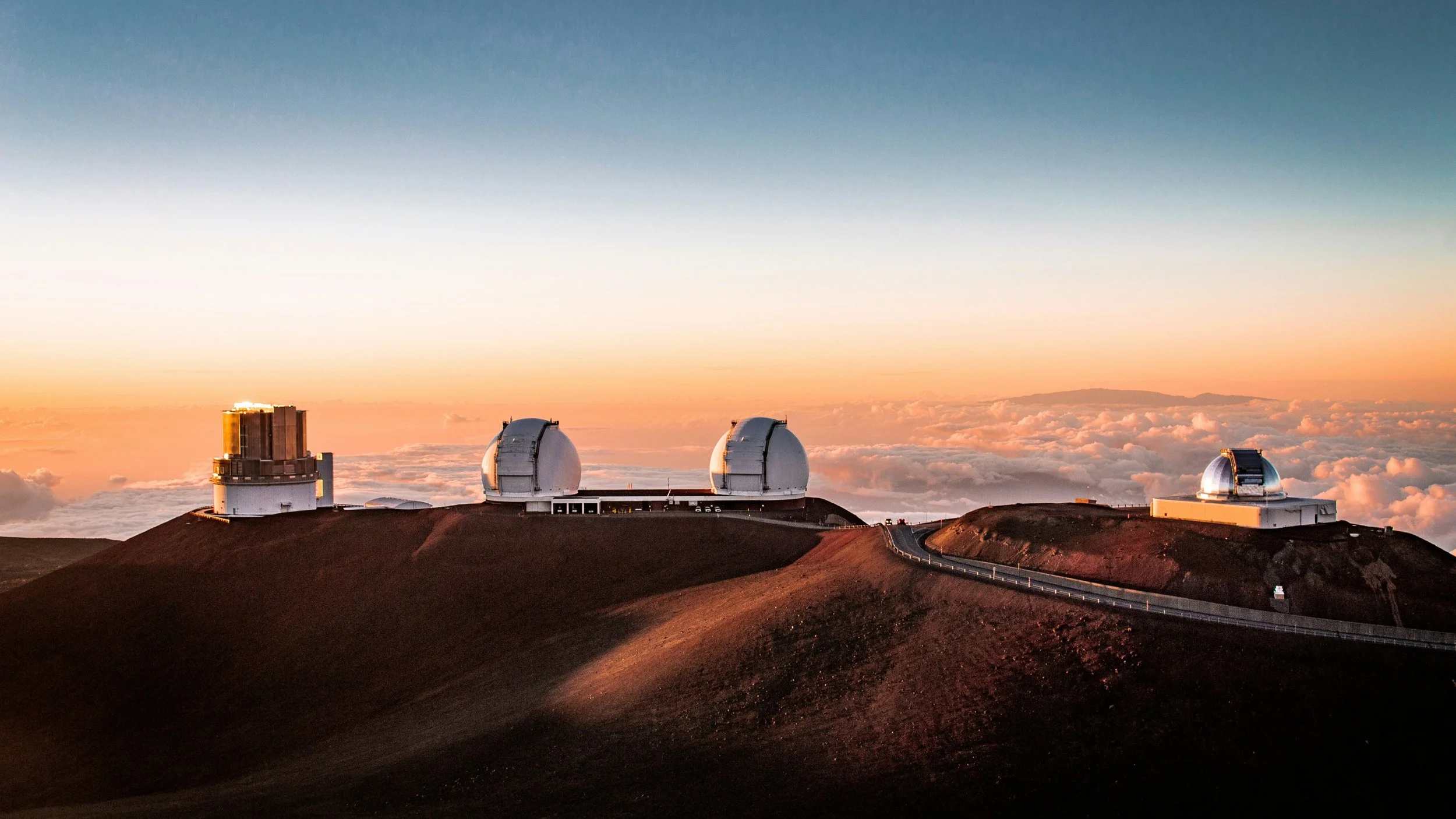
Earth observation infrastructure at Mauna Kea, Hawai’i, Credit: Peter Luo
For me, the construction of Mauna Kea as ‘empty’ and the building of structures there as ‘no big deal’ depends on two acts of unseeing. First, following early Western explorers and colonizers in the 19th century, Mauna Kea was framed as both empty of human civilization and emptied through what Hi’llei Julia Hobart terms “deanimation” – the emptying out of Indigenous lifeworld by recasting the mountain as empty. Second, conceptualizing Mauna Kea as a ‘pure’ site of science detaches the mountaintop telescopes from ongoing histories of dispossession and settler colonialism in Hawai’i. So, in searching for the pure view from space untroubled by the mistakes of the past, we risk unseeing and legitimating injustices and exclusions here on Earth.
Laura: This resonates very deeply with me. What I find particularly fascinating is how your empirical cases fracture the vision of everything, of the Earth as a whole, by tying it back to the ground, to human embodied and emplaced experience and struggle.
Zooming In and Zooming Out: The Question of Scale
Laura: In a more theoretical register, I feel your work also speaks to questions of scale and scaling. The notion of ‘scale’ is generally taken to problematize magnitude. More precisely, it attends to the frictions and discontinuities that emerge when relations among things / persons / ideas shift under conditions of changing volume, spatial extension, reach and so on. In his 2020 book,
The Cosmic Zoom, Zachary Horton, describes how:
Scales that we … had taken for granted are suddenly … blocking the path both forward and back … everything seems different, as if the borders between things have slipped out of focus. We may adjust our glasses and wipe our screens, but it isn’t entirely clear [what] has changed scale.
Joanne: Reflecting on this quote, it occurs to me that maybe our fixation with ‘focus’ parallels our quest to see the Earth in its entirety as a majestic whole. I think the promise of this vision is that everything is in focus at the planetary scale. And that’s the promise of telescopes – the larger the telescopes, the more things they promise to show us in focus: from distant galaxies to the beginnings of the universe. But as Karen Barad and others have argued, this makes large telescopes the search for the Archimedean point, an idealized view from nowhere. The problem is that it is a false promise – as some things come into focus, others slip out of focus. Perhaps what we need to realize is that there is no solution to the problem of focus and we must reconcile ourselves to always seeing some parts of the universe out of focus.
The Parts and the Whole: ‘Up-there’ and ‘Down-here’
Joanne: In studying societies, we often face this question of the relationship between the parts and the whole. In particular, we study how societies are not reducible to their individual elements – in other words, the whole is not just the sum of its parts. But sometimes, in focusing on the whole, we lose sight of the parts, and everything becomes homogenized as merely expressions of the whole. In some ways, this vision becomes a form of totalitarianism where everything is subsumed within a coherent whole.
I think the question of how the whole relates (or ought to relate) to the parts is a fundamental question for those of us who study societies and their interactions, and the multiplicity of visions of how the two interrelate (or ought to interrelate), in competing visions of global politics.
Laura: I completely agree. The question of the whole and the parts, as referenced in the title of your keynote, opens up yet another register in which to explore the politics of planetary visions, connecting the ‘up there’ of the view from space with the Earthly ‘down here’ that remains tied to the ground.